Servo Motors vs Stepper Motors: Precision in Motion
Compare servo and stepper motors by accuracy, torque-speed, control, and cost—learn which drive delivers true precision for your motion application.
Understanding Motion Control
Servo motors and stepper motors both convert electrical energy into precise mechanical motion, yet they do so with distinct philosophies. A stepper motor advances in discrete increments, or steps, using an open-loop approach: the controller assumes each commanded step is completed. This simplicity makes steppers approachable, predictable at low speeds, and strong in holding torque without complex feedback. A servo motor, by contrast, operates in closed-loop with an encoder or resolver reporting actual position back to a controller, which continuously corrects errors. That feedback enables smooth motion, higher dynamic response, and sustained performance across varying loads. Steppers shine in cost-sensitive, compact systems where modest speeds and precise incremental moves are enough. Servos excel when you need faster moves, better accuracy under load, and adaptability to changing conditions. Understanding this open-loop vs closed-loop divide is the first step in selecting the right motor architecture for reliable, repeatable, and efficient motion.
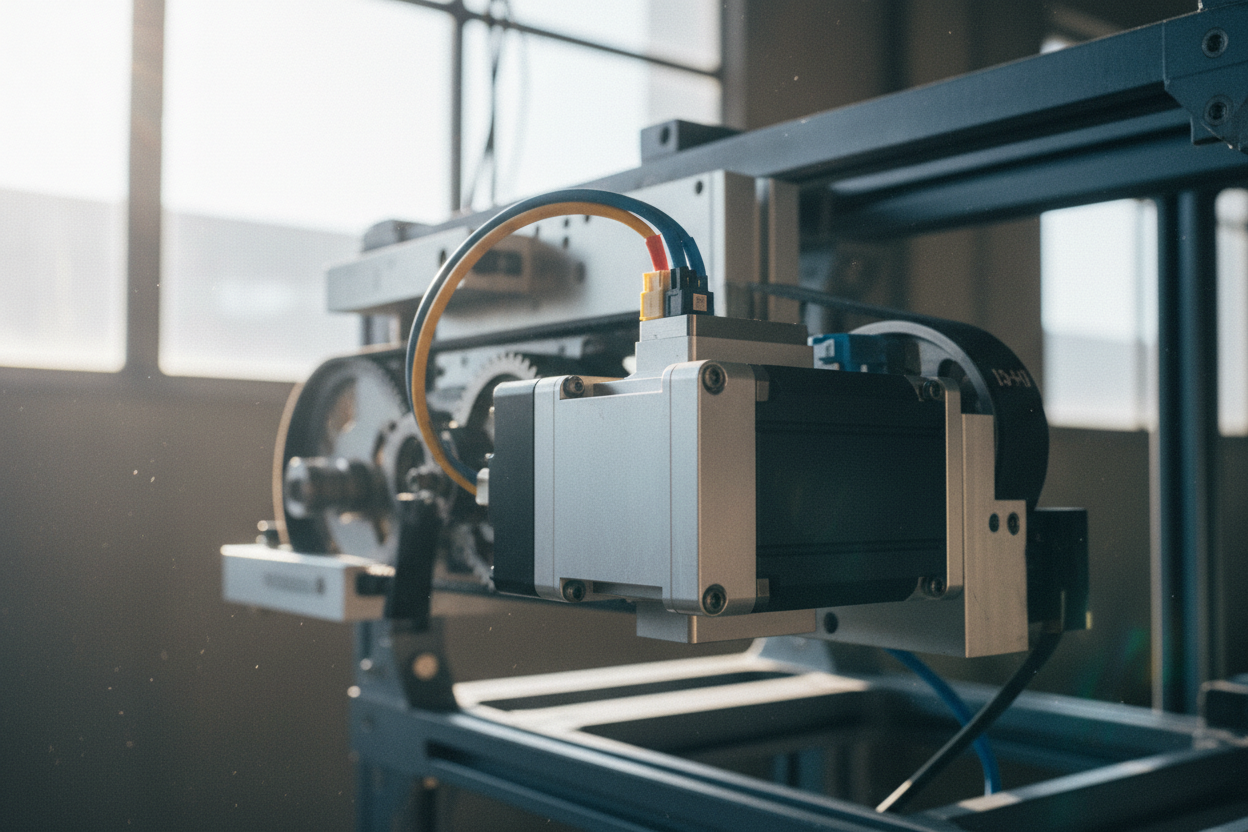
Accuracy, Resolution, and Repeatability
Precision has multiple facets: resolution, accuracy, and repeatability. A stepper offers innate resolution via its step angle, with microstepping further subdividing movement for smoother motion and finer command granularity. However, microstepping primarily improves smoothness; true accuracy can still be limited by torque linearity, load changes, and mechanical factors. A servo derives resolution from its encoder counts and any gear reduction, allowing high effective resolution and the ability to correct position errors as they occur. Accuracy reflects not just the motor but the entire mechanism: backlash, compliance, bearing play, and alignment all influence results. Repeatability often favors both technologies in well-designed systems, yet servos typically maintain precision under variable forces because the loop actively compensates. Homing routines, limit switches, and calibration improve both platforms. When the application demands precise placement under changing loads, or exact path tracking over long cycles, a servo's continuous error correction provides a tangible advantage.
Torque, Speed, and Efficiency Trade-offs
Motor choice often hinges on torque-speed characteristics. Stepper motors deliver strong low-speed torque and solid holding torque, ideal for indexing and positioning without drift. As speed rises, inductance and back EMF reduce available torque, creating a practical ceiling and potential resonance zones that can induce vibration or missed steps. Servo motors can sustain torque over a broader speed range and maintain efficiency while accelerating and decelerating rapidly. Their closed-loop control actively supplies just enough current to meet demand, often reducing heat at standstill compared to a stepper driven at high holding current. Gearboxes or belt reductions can reshape the torque-speed envelope for either technology, trading speed for torque or vice versa. For high-throughput motion profiles with frequent starts and stops, a servo's dynamic torque and faster settling can improve cycle time. For steady, moderate-speed moves where energy efficiency at rest and cost are priorities, a stepper remains a dependable, budget-friendly choice.
Control Strategies and Electronics
Control electronics shape behavior as much as the motor itself. Stepper drivers use current limiting and microstepping to achieve smooth motion, typically accepting simple step/dir signals from a controller. Commissioning is straightforward: define steps per unit, set current, and tune acceleration limits to avoid stalls. Servo drives integrate position, velocity, and sometimes torque loops, relying on PID control with options like feedforward, anti-windup, and filters to tame resonance. They accept richer command sets—pulse trains, analog references, or digital fieldbuses—and report diagnostics, faults, and precise status. Tuning a servo involves setting gains, inertia estimates, and limits for current, speed, and travel, often with auto-tuning that gets you close before fine refinement. Safety features such as soft limits, overcurrent protection, and safe torque off bolster reliability. In short, steppers prioritize simplicity; servos prioritize adaptability. Your team's expertise and tooling can tip the balance toward a platform that matches both performance and maintainability needs.
Integration, Tuning, and Reliability
Real-world performance depends on integration. For servos, inertia matching between motor and load improves stability and responsiveness; couplings, gear ratios, and belt drives should be selected to minimize backlash while preserving stiffness. Steppers benefit from conservative acceleration ramps, damping solutions for resonance, and power supplies sized for peak current. Both benefit from careful cable routing to reduce EMI, adequate thermal management, and aligned shafts to prevent premature bearing wear. Consider absolute vs incremental encoders for homing strategies; an absolute feedback device can eliminate homing cycles, saving time and reducing collision risk. Noise profiles differ too: steppers can exhibit audible tones at certain microstep frequencies, while servos may hum lightly as they hold position. Reliability follows good practice: robust connectors, strain relief, sealed enclosures for harsh environments, and routine inspections. While a stepper's simplicity can be an asset, a properly tuned servo with the right mechanics can deliver years of consistent, drift-free motion under demanding duty cycles.
Choosing the Right Motor for the Job
Selection starts with a clear requirements matrix: target positioning accuracy, repeatability, move distance, maximum speed, payload mass, duty cycle, ambient conditions, and budget. If your application centers on modest speeds, frequent holds, and predictable loads—think conveyor indexing, valve actuation, or light pick-and-place—a stepper motor offers compelling value with minimal complexity. For high-speed contours, variable loads, and tight tolerances—common in robotics, CNC, gimbals, and lab automation—a servo motor typically prevails due to closed-loop correction and superior dynamic control. Consider closed-loop steppers when you need feedback without the full cost and speed envelope of a servo. Factor total cost of ownership: drivers, feedback devices, gearboxes, commissioning time, and energy use at standstill. Finally, design for scalability. If future cycles demand faster throughput or heavier tools, choosing a platform with headroom—often a servo—can protect your investment while safeguarding precision in motion.