Understanding Torque and RPM: How Motors Deliver Power
Learn how torque and RPM combine to make power, why gearing matters, and how different motors trade speed, pulling force, and efficiency.
Torque and RPM Basics — At the heart of every motor are two intertwined ideas: torque and RPM. Torque is the twisting effort a motor applies to a shaft, the rotational counterpart to linear force. RPM measures how fast that shaft turns, indicating rotational speed. Imagine loosening a bolt: a longer wrench gives you more torque; spinning that wrench faster raises the speed. Motors turn electrical or chemical energy into rotation by balancing these elements to produce power. In simple terms, power grows when either torque or speed increases, which is why a motor that spins quickly with little torque can deliver comparable power to a slower motor with high torque. This balance decides how a system accelerates, holds a load, or reaches a desired speed. Understanding the trade-off between twisting force and rotational speed is the foundation for choosing, controlling, and optimizing motors across applications from fans to conveyors to electric drivetrains.
From Rotation to Usable Power — Power is the rate at which work is done, and in rotating systems it is the product of torque and angular velocity. If you picture torque as the shove and angular velocity as how quickly that shove makes the shaft turn, their multiplication yields the motor's output power. Many motors exhibit a constant-torque region at lower speeds where they can push hard even when turning slowly, and a constant-power region at higher speeds where torque gently declines as RPM rises. This behavior matches real-world needs: lifting a heavy load requires torque at low RPM, while cruising at speed prioritizes RPM with moderated torque. Continuous and peak ratings matter, too. Peak torque handles bursts like startup or sudden impacts, while continuous torque defines what the motor can sustain thermally without overheating. Matching these ratings to your application ensures smooth acceleration, efficient cruising, and reliable long-term performance.
Gearing and Mechanical Advantage — Gears, belts, and pulleys trade torque for RPM to create mechanical advantage. A gear reduction lowers speed while multiplying torque, helping a motor handle heavier loads without stalling. Conversely, a gear increase boosts RPM at the expense of torque, ideal when you need high speed with light load. While ideal gears conserve power aside from losses, real systems introduce efficiency penalties from friction, misalignment, and backlash. Selecting a ratio is about keeping the motor operating near its sweet spot, where efficiency and cooling are favorable. For example, a conveyor with variable loads might use reduction gearing so the motor runs in a strong, thermally comfortable range rather than straining at low RPM. Consider inertia as well: higher reduction reduces the reflected inertia the motor must accelerate, improving responsiveness. Proper gearbox selection, lubrication, and mounting help contain noise, reduce heat, and extend service life, ensuring the entire drivetrain transforms torque and speed into reliable output.
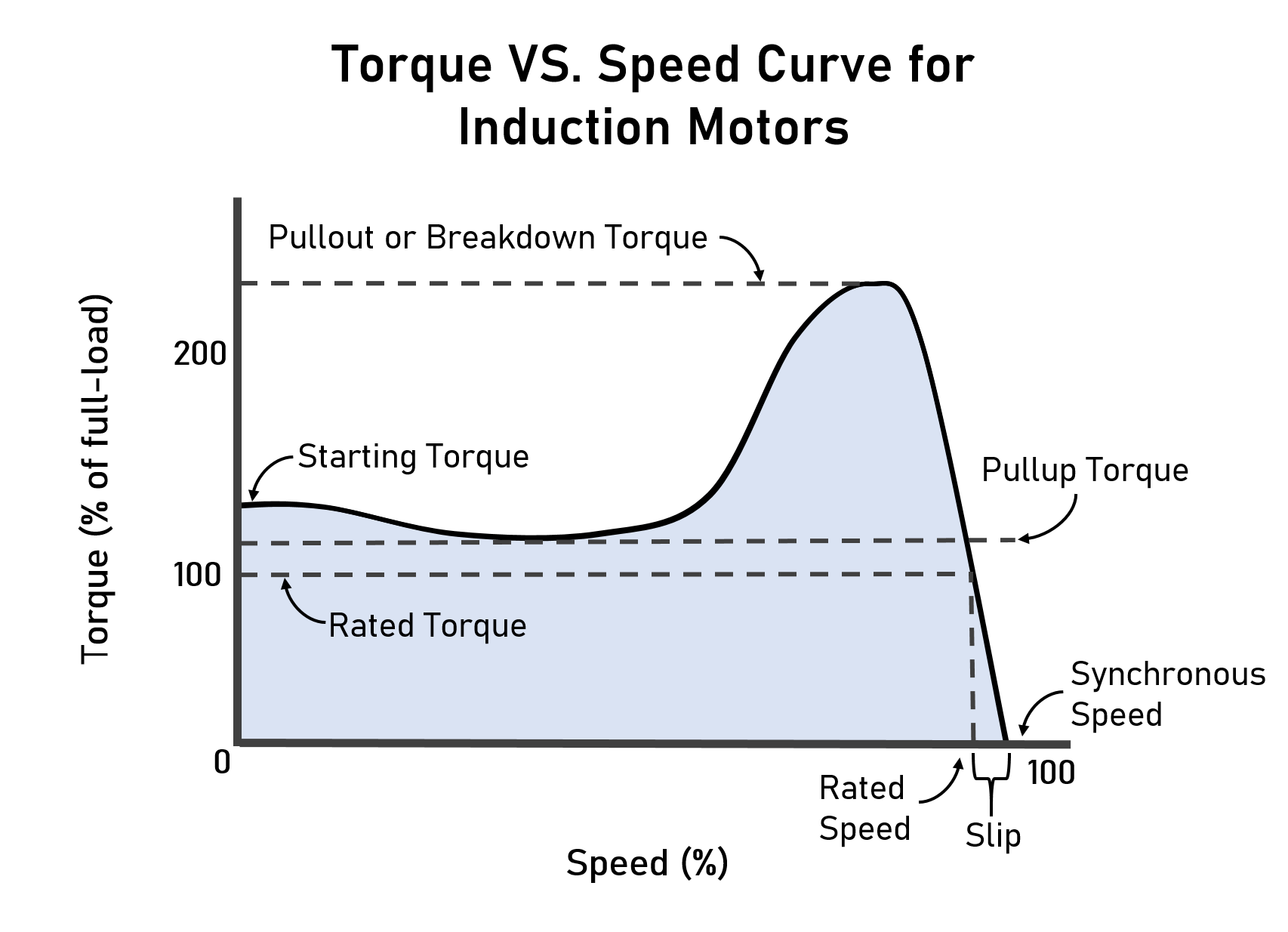
Motor Types and Torque Curves — Different motor types write different torque stories. Brushed DC motors show a roughly linear speed–torque curve from stall torque down to no-load speed, making them intuitive to model. Brushless DC (BLDC) motors typically deliver strong, flat torque at lower RPM and then taper as back electromotive force rises, enabling efficient, responsive control. Induction motors produce torque through slip, excelling with variable frequency drives that unlock wide operating ranges. Synchronous machines maintain a locked electrical–mechanical phase and can achieve high efficiency and precise speed regulation. Stepper motors provide high holding torque at low speeds with discrete steps, ideal for positioning but less suited to high-RPM power delivery. Terms like stall, rated speed, and torque ripple shape user experience: stall identifies maximum static twist, rated speed marks continuous operating comfort, and ripple describes small torque oscillations that can induce vibration. Understanding each curve helps match motors to loads with predictable, stable behavior.
Sizing for Real-World Loads — Proper motor selection begins with the load profile. Determine whether the application is constant torque (conveyors, positive displacement pumps), variable torque (fans, centrifugal pumps), or constant power (certain traction scenarios). Factor in duty cycle to gauge how long the motor runs at given levels, and compute RMS torque to capture the heating effect of varying demand. Consider inertia of both the load and transmission; accelerating high inertia requires additional torque to meet a desired acceleration time. Identify starting torque needs, friction, gravity components, and any transient shocks. Then apply a reasonable safety margin so the system tolerates real-world variability without over-stressing components. Thermal performance is critical: continuous ratings assume adequate cooling, while intermittent peaks must respect thermal time constants. The best choice is often a motor that keeps operating points in its efficient region when paired with appropriate gearing and control, balancing compact size, longevity, and energy cost.
Sensing and Control of Torque and Speed — Delivering consistent performance requires feedback. RPM is commonly measured with encoders, tachometers, or Hall sensors, while torque can be inferred from current in many motor types or measured directly with a torque transducer. Closed-loop control uses this feedback to regulate speed or torque precisely. PID controllers manage simple loops well, while advanced methods like field-oriented control (FOC) for AC and brushless motors decouple torque and flux for smooth, efficient response. Variable frequency drives for induction and synchronous machines, and dedicated controllers for BLDC or brushed DC, enable soft-start, ramps, and regenerative braking where applicable. Attention to torque ripple and cogging improves low-speed smoothness; filtering, proper commutation, and careful current control help. Well-tuned control not only enhances stability and efficiency but also protects components from overloads, ensuring the motor tracks the command without excessive heat, noise, or mechanical stress.
Efficiency, Heat, and Reliability — Every motor converts some input into losses: copper I²R heating in windings, core losses from magnetic cycling, and friction and windage from bearings and air movement. These losses become heat, raising temperature and stressing insulation, magnets, and lubrication. Operating near the highest efficiency point reduces waste, shrinks cooling demands, and lengthens life. Good thermal management includes proper airflow or liquid cooling, correct enclosure selection, and clean mounting to heat-sinking surfaces. Pay attention to bearings: alignment, preload, and lubrication greatly influence noise and durability. Vibration from imbalance, misalignment, or torque ripple accelerates wear, so balancing and rigid frames matter. Oversizing can run cooler but may hurt efficiency and cost; right-sizing with smart control typically wins. By pairing the correct motor, gearing, and controller, and maintaining clean power and cooling paths, you preserve reliability, keep energy bills in check, and ensure the motor's torque and RPM translate into dependable, long-lived power.